Customer Value
Customer Reactivation for Rental Companies: How to Turn Past Customers Into Repeat Revenue
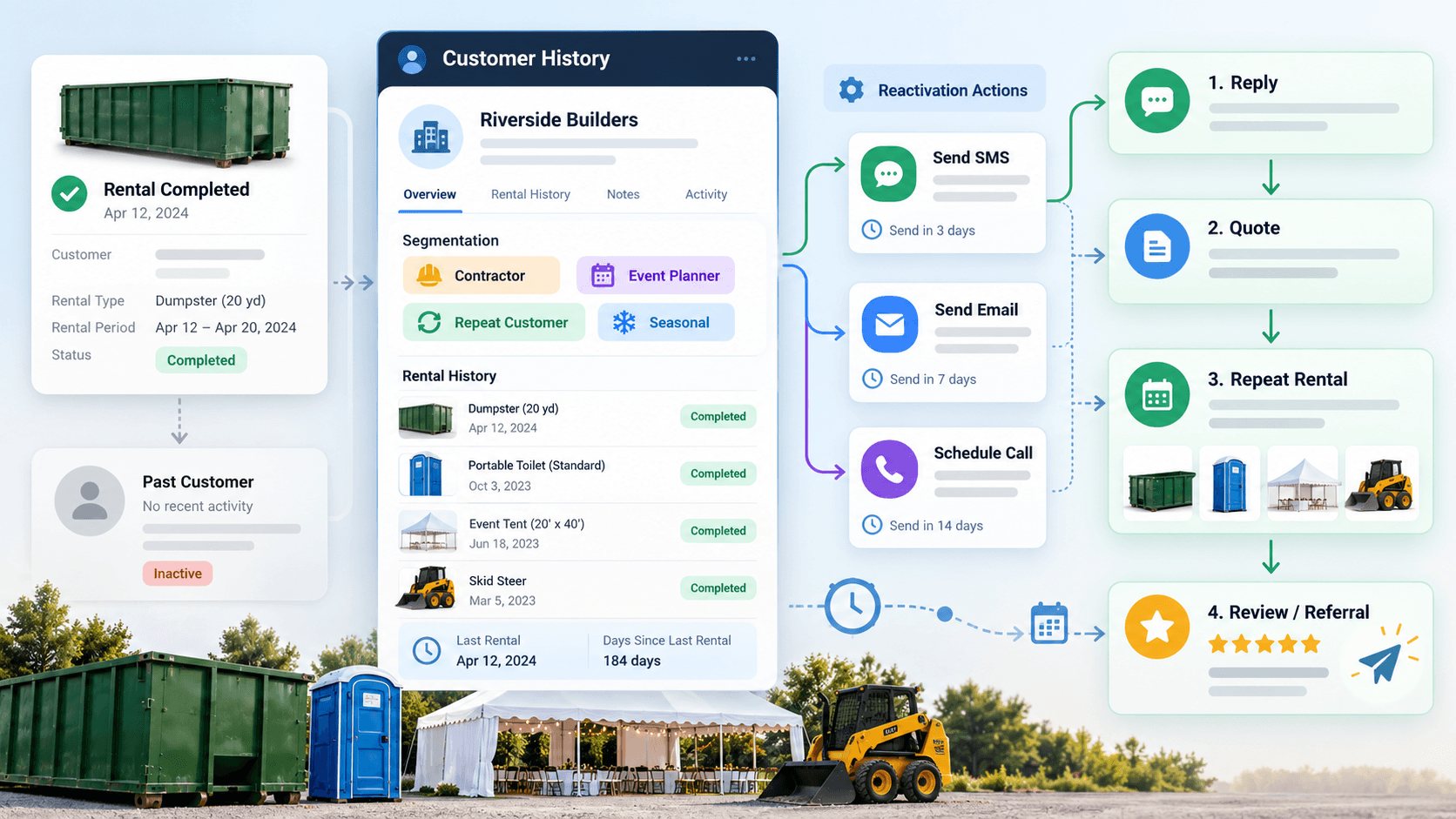
A rental company reactivates past customers by keeping accurate customer history, segmenting that list instead of treating it as one group, identifying who's likely to have a repeat need, reaching out at a relevant time through SMS, email, or a call, automating the reminder where it makes sense, and tracking what actually happens afterward.
That's a different thing than mass marketing to an old customer list. A past customer sitting untouched in a CRM isn't really a reactivation strategy — it's storage. Reactivation is about relevance and timing, not volume.
What Is Customer Reactivation?
Customer reactivation means reconnecting with a past customer who isn't currently renting but may have another relevant need, with the goal of turning that relationship back into a booking.
- Active customer — currently renting or mid-relationship
- Repeat customer — has rented more than once, on some pattern
- Inactive customer — hasn't rented in a while but hasn't explicitly left
- Lapsed customer — inactive long enough that the relationship has gone cold
- Reactivation opportunity — an inactive or lapsed customer with a plausible, specific reason to rent again
Why Reactivation Matters for Rental Companies
Rental businesses are particularly well suited to this because so many customers have genuinely recurring needs: contractors move between projects, event planners run events on a calendar, venues host multiple events a year, homeowners eventually have another cleanout or remodel, and municipalities and commercial accounts tend to have ongoing requirements.
A past customer already knows the business — what it offers, how it operates, whether the experience was good. That relationship starts with more context than a brand-new lead, which is the main reason reactivation is worth a deliberate system rather than an occasional afterthought. It's also the reason a reactivation conversation tends to move faster than a cold one: there's no need to re-explain who the company is or what it does.
Which Past Customers Should You Reactivate?
Not every past customer is a good reactivation candidate. A few categories worth building around:
Recent customers
Completed a rental recently and may have another need soon.
Repeat customers who went quiet
Had a prior recurring pattern that suddenly stopped.
Seasonal customers
Tied to events, construction seasons, or annual projects.
Contractors and commercial accounts
Have recurring jobsite needs on an ongoing basis.
Event planners and venues
Rental needs that repeat predictably throughout the year.
One-time customers with predictable future needs
Homeowners, property managers, and businesses with a plausible next project.
Use Customer History to Decide Who to Contact
Better customer history creates better reactivation. Useful data points include:
- Last rental date
- Rental category and unit or equipment rented
- Customer type
- Rental frequency
- Service area
- Job or event type
- Original lead source
- Quote history, including won/lost outcomes
- Communication history
- Review status
- Referral history
Segment Past Customers Before You Contact Them
A few practical segments: dumpster contractors, homeowners, portable toilet construction customers, portable toilet event customers, restroom trailer event planners, equipment contractors, event rental planners, and repeat commercial accounts.
Sending the same "we miss you" message to a contractor and a one-time homeowner is technically follow-up. It just isn't very thoughtful follow-up — each segment has a different reason to rent again, and the timing and message should reflect that.
When Should a Rental Company Reactivate a Past Customer?
Timing should reflect the customer's likely need cycle, not a fixed calendar date. Reasonable triggers include:
- Based on the customer's normal rental frequency
- Ahead of seasonal demand relevant to their category
- Around the anniversary of a past event
- Before construction season ramps up
- After a reasonable period of inactivity for that customer type
- When a related service becomes newly relevant
What Should a Reactivation Message Say?
- Identify the customer and the context
- Reference the prior relationship when it's appropriate
- Give a relevant, specific reason for reaching out
- Make the next step easy
- Keep it short
Contractor example
"Hi [Name], wrapping up a project soon? Happy to get a dumpster scheduled whenever you need one."
Homeowner example
"Hi [Name], it's been a while since your last rental with us. Starting a new project this year? We're happy to help."
Event planner example
"Hi [Name], event season is coming up. Want to get your restroom trailer dates locked in early this year?"
Commercial account example
"Hi [Name], checking in ahead of your next cycle — let us know if you'd like to set up recurring service again."
Should You Use SMS, Email, or Phone?
SMS
Simple, fast, and conversational — a good fit when texting was already part of the relationship.
Useful for commercial accounts, gives more room for context, and works well for seasonal reminders.
Phone
Valuable for high-value accounts and recurring contractor relationships, where personal context matters.
The reliable rule is to use whichever channel the customer already communicates through. And regardless of channel, outreach should honor opt-outs and any applicable messaging and marketing requirements — this isn't legal advice, but it's a baseline any reactivation system should build in from the start.
Can Customer Reactivation Be Automated?
Yes, when it's built thoughtfully. Good automation candidates:
- Tag a customer after a completed rental
- Store and calculate the last-rental date
- Create a follow-up task automatically
- Enter the customer into the appropriate segment
- Trigger a seasonal reminder
- Send a personalized SMS or email
- Alert a salesperson for high-value accounts
- Stop the workflow the moment a customer books
Automate the reminder and the routing; preserve human judgment where it actually matters. This connects directly to Digital Infrastructure and the CRM that holds the data driving it.
Examples of Rental Customer Reactivation Campaigns
Dumpster rental
Past contractor customers approaching another likely project cycle.
Portable toilets
Construction customers with recurring jobsite needs.
Restroom trailers
Wedding and event planners approaching the next event season.
Event rentals
Planners and venues with events that repeat on a calendar.
Equipment rentals
Contractors with ongoing or upcoming project needs.
How Reactivation Differs for Contractors vs. Homeowners
Contractors
Recurring needs, project-cycle timing, a more relationship-based dynamic — more frequent contact can genuinely be relevant here.
Homeowners
Less frequent, more event- or project-driven, and better served by more selective, less frequent follow-up.
The same automation shouldn't treat both groups identically — a contractor getting quarterly check-ins makes sense; a homeowner getting the same cadence starts to feel like spam.
How Reactivation Works With Reviews and Referrals
A reactivation workflow is also a convenient place to catch gaps: customers who never received a review request, happy customers who might refer others, repeat customers who tend to be good referral sources, and customers whose past feedback hints at another opportunity.
See our guide on getting more Google reviews for more on asking well — the short version here is the same: ask consistently and honestly, never incentivize a positive review specifically.
How Reactivation Creates More Customer Value
Customer value isn't only about raising prices. It grows through repeat rentals, relevant cross-sells, additional services, referrals, reviews, and longer relationships overall — the operational core of Customer Value Systems. A contractor who rents from the same company for three years is worth more than the sum of those individual rentals, simply because the relationship removes friction from every job after the first one.
Common Customer Reactivation Mistakes
- Blasting every past customer with the same message
- Sending offers that aren't actually relevant to that customer
- Contacting people too frequently
- Ignoring customer history entirely
- Skipping segmentation and treating the list as one group
- Sending messages with no context about the prior relationship
- Forgetting to honor opt-outs
- Letting automation keep running after a customer already responded or booked
- Measuring messages sent instead of bookings and revenue
Automation without segmentation just gets the irrelevant message out faster.
How to Track Reactivation in Your CRM
Useful fields and tags:
- Last rental date
- Customer segment
- Last reactivation contact
- Next reactivation date
- Reactivation campaign
- Response
- Booked or not booked
- Rental category
- Customer type
If your customer database only gets opened when someone needs to find an old phone number, there's probably more revenue hiding in it than you'd think.
What Should a Rental Company Automate First?
- Track completed rentals
- Store the last-rental date
- Segment customers
- Create reactivation eligibility rules
- Start with one customer segment
- Create one SMS or email campaign
- Add salesperson tasks for high-value accounts
- Track replies and bookings
- Improve based on what actually happens
A Simple Rental Customer Reactivation Workflow
Completed rental, customer history updated, customer segmented, reactivation date reached, SMS/email/call sent, customer responds, quote or booking, new rental, review or referral, future reactivation. Each step feeds the next — if one is missing, the chain stalls at that point rather than producing a repeat booking.
How Often Should You Run Reactivation Campaigns?
There's no single universal schedule that fits every rental company. The right cadence depends on customer type, normal rental frequency, seasonality, category, and the customer's own past behavior — a contractor on a monthly project cycle and a homeowner who rents once every few years need very different timelines, not the same quarterly blast.
How Do You Know If Reactivation Is Working?
Simple operational metrics worth watching: customers contacted, replies, conversations started, quotes sent, bookings, repeat rentals, revenue tied back to reactivated customers, opt-outs, and performance by segment. Tracking by segment specifically tends to be the most useful cut — it's usually how a company discovers that one group responds well and another doesn't, rather than concluding reactivation broadly does or doesn't work.
What Should a Rental Company Work on First?
- Clean the customer database
- Track last rental date
- Identify customer types
- Build simple segments
- Pick one high-potential segment
- Write one relevant message
- Send manually first if needed
- Track responses
- Automate once the process works
- Expand to other segments
The Bottom Line
Rental companies don't always need more leads. Sometimes they need to do more with the customers they already earned.
A good reactivation system uses customer history, segmentation, timing, relevant follow-up, and automation to create more repeat opportunities — without turning the customer database into a spam list. It's the same idea behind Customer Value and Digital Infrastructure working together: the tech stack holds the history, and the system decides what to actually do with it.
Frequently Asked Questions
What is customer reactivation for a rental company?
Customer reactivation is the process of reconnecting with a past customer who isn't currently renting but may have another relevant need, with the goal of turning that relationship into another booking rather than letting it sit idle.
How do you reactivate past rental customers?
By keeping accurate customer history, segmenting past customers instead of treating them as one group, identifying who's likely to have a repeat need, reaching out at a relevant time, and tracking what happens afterward so the approach can improve.
When should a rental company contact an old customer?
Timing should match the customer's likely need cycle — based on their normal rental frequency, ahead of seasonal demand, around the anniversary of a past event, or after a reasonable period of inactivity for that customer type. There's no single universal timeframe that fits every business.
Can rental customer reactivation be automated?
Yes. Tagging completed rentals, storing last-rental dates, segmenting customers, and triggering reminders can all be automated. Human judgment should stay involved for high-value accounts and anything that needs real context, and automation should stop once a customer responds or books.
What should a rental customer reactivation message say?
Identify the customer and context, reference the prior relationship when appropriate, give a specific and relevant reason for reaching out, make the next step easy, and keep it short. A generic "we miss you" message sent to everyone isn't a reactivation strategy.
How often should a rental company contact past customers?
It depends on customer type, rental frequency, seasonality, and category rather than a fixed universal schedule. A contractor with recurring projects can reasonably hear from a company more often than a homeowner with an occasional one-time need.
Which rental customers are the best candidates for reactivation?
Recent customers who may have another need soon, repeat customers who went quiet, seasonal customers tied to events or project cycles, contractors and commercial accounts with recurring needs, and event planners or venues with predictable future rentals.
Related Resources
Customer Value
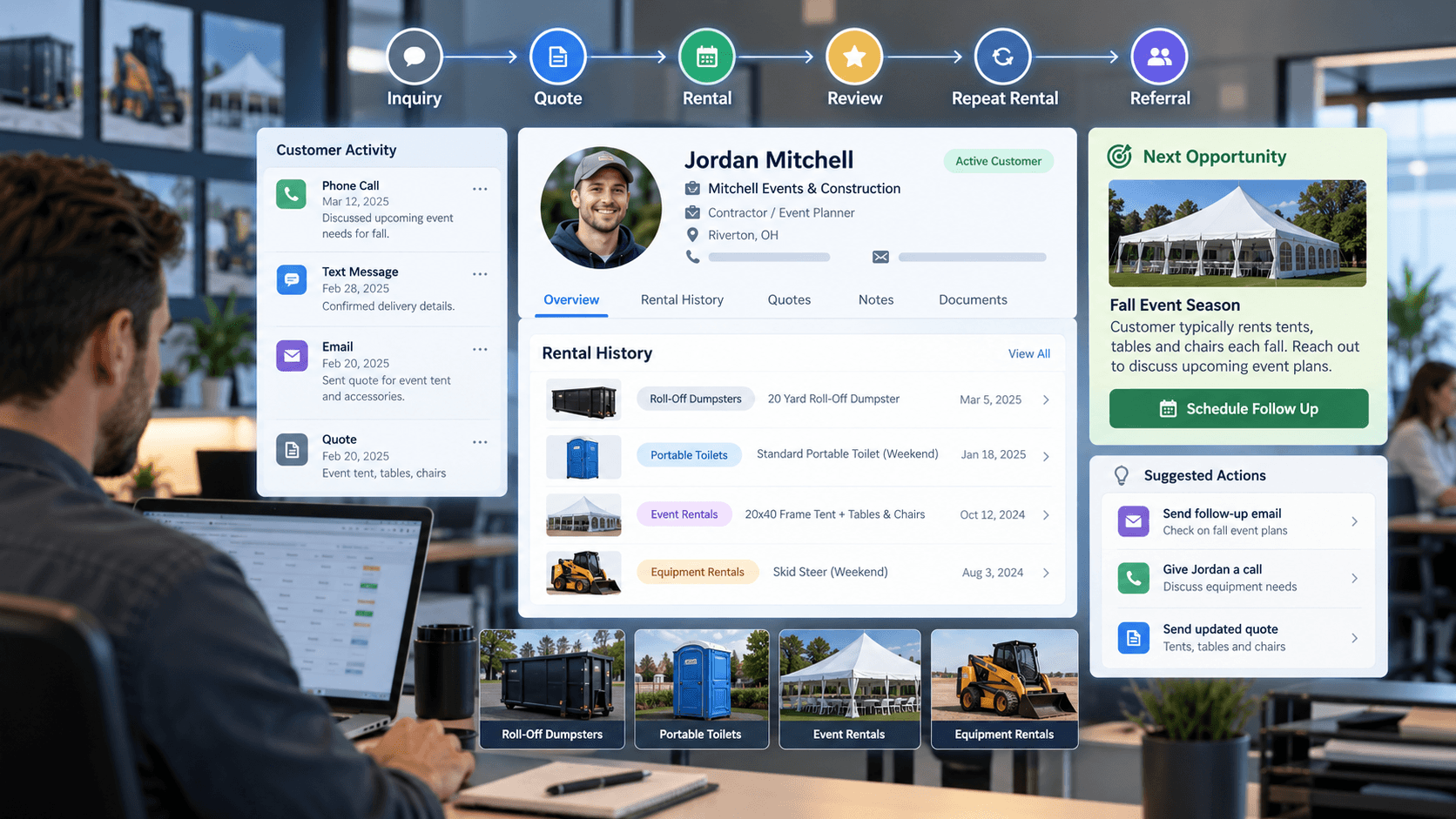
How to Track Customer History in a Rental Business (and Actually Use It to Grow)
A practical way to track customer history — and the follow-up, reactivation, and repeat-business system that actually puts it to use.
Customer Value
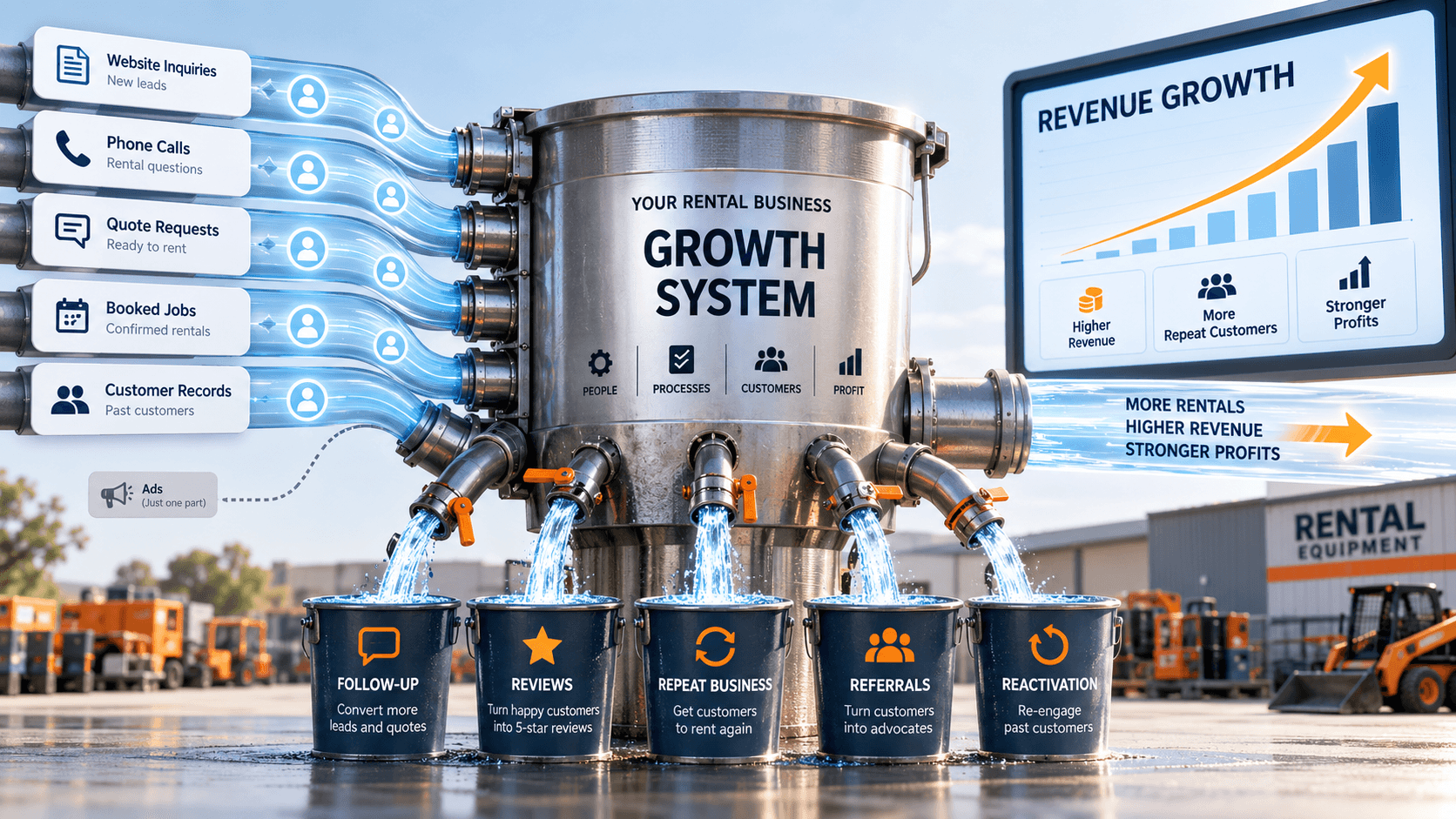
How to Grow a Rental Business Without Spending More on Ads
More ad spend isn't always the answer — here's how rental companies create growth from the leads and customers they already have.
Digital Infrastructure
What CRM Should a Rental Company Use? A Practical Guide to Leads, Quotes, Follow-Up, and Repeat Business
What a CRM actually needs to do for a rental company — lead capture, pipeline visibility, follow-up automation, and reactivation — not which brand to buy.