Customer Acquisition
SEO for Construction Equipment Rental Companies: How to Rank in Google Maps and Local Search
A construction equipment rental company improves its Google Maps and local search visibility by strengthening several things at once: an accurate Google Business Profile, clear equipment category pages, useful individual machine pages, genuinely helpful city pages, project-oriented content, reviews, internal links, third-party mentions, and a website that makes it easy to request a quote.
None of these work especially well in isolation. A strong Google Business Profile attached to one generic "Equipment Rental" page won't hold up in organic search for "skid steer rental near me" or "mini excavator rental [city]." Companies that rank consistently for these searches usually have most of these pieces working together.
How Local Search Works for Equipment Rental Companies
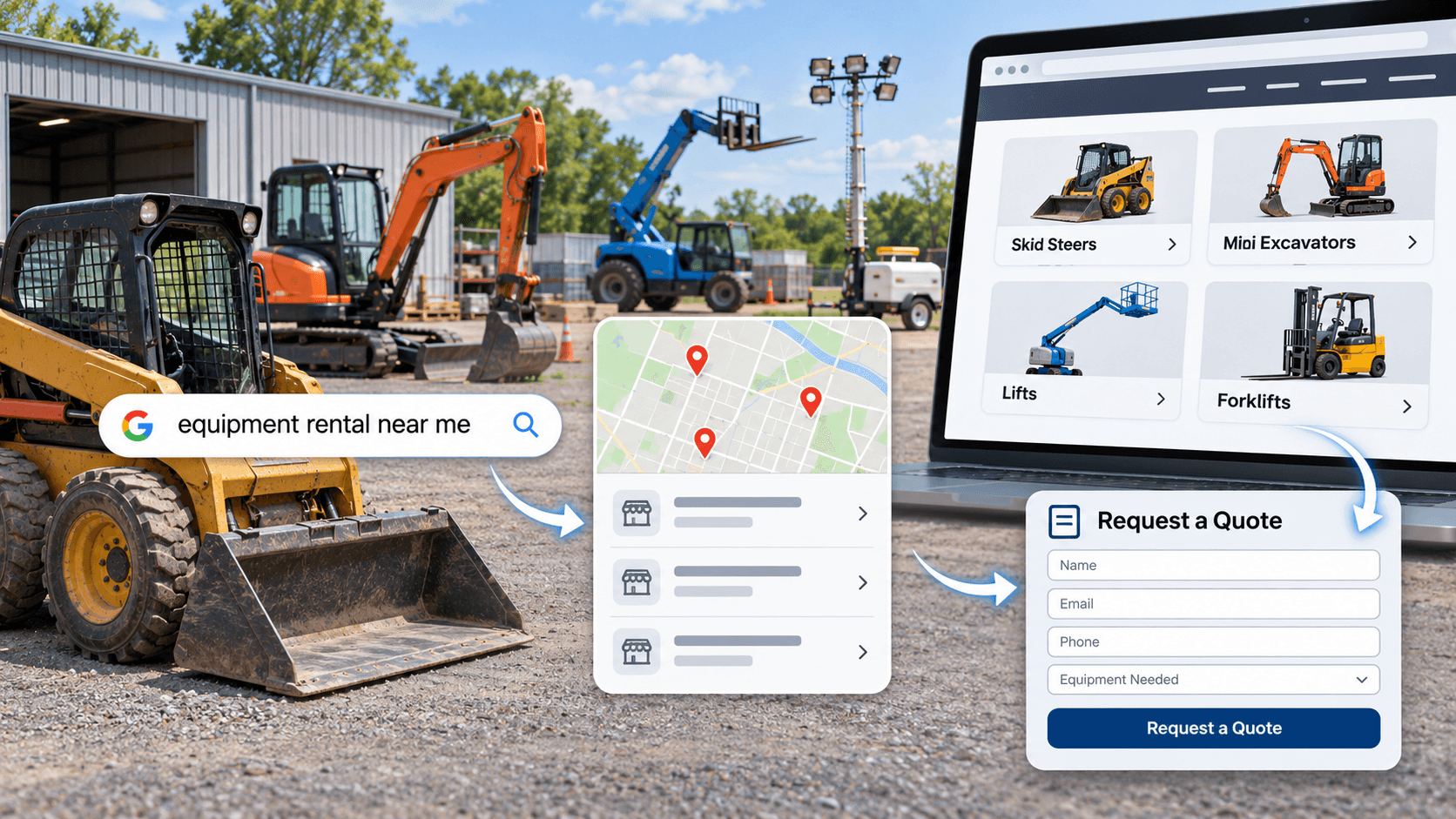
Equipment rental customers find companies through three overlapping surfaces that reward mostly the same signals.
Google Maps and the Local Pack
The map pack — local listings shown above organic results for a "near me" or city-plus-equipment search — is usually the first thing a contractor or homeowner sees, driven by profile completeness, relevance, and proximity.
Organic search results
Below the map pack, a website competes on content, structure, and authority for searches like comparing a skid steer to a compact track loader or figuring out what size excavator a job actually needs.
AI-generated and conversational recommendations
AI-generated summaries and conversational tools pull from the same underlying information — business details, reviews, and published content — to answer a question directly.
The goal isn't "ranking" in the abstract — it's showing up for specific, high-intent searches: skid steer rental near me, mini excavator rental [city], equipment rental [city], forklift rental [city], telehandler rental [city], construction equipment rental near me, equipment rental for contractors.
Optimize Your Google Business Profile
Choose the primary category that actually matches the business — an equipment or tool rental category — and add secondary categories only where genuinely accurate. The description should plainly describe what's offered and where, not every machine the business wants to rank for, and stuffing keywords into the business name tends to backfire.
Service areas should reflect where the company actually delivers, hours should be current, and the phone number should be the one that's actually answered. Real photos of equipment, deliveries, and job sites outperform stock imagery, and a profile that collects reviews steadily reads as active — one filled out once and never touched again reads as exactly that.
Build Strong Equipment Category Pages
One generic "Equipment Rental" page trying to represent skid steers, excavators, lifts, generators, and storage containers at once is rarely enough. If every machine on the lot is fighting for attention on one generic page, Google is not the only one who may get confused.
Category pages are worth building where relevant for:
- Skid steers
- Mini excavators
- Lifts
- Forklifts
- Generators
- Trenchers
- Compactors
- Telehandlers
- Storage containers
Each category page should clearly cover what's available, common use cases, service area, delivery and pickup, availability considerations, FAQs, and a clear quote path — not just a product list.
Should Equipment Rental Companies Create Individual Machine Pages?
Yes, when the page provides genuinely useful information and the equipment is something customers actively search for. A skid steer page with one photo, a model number, and no useful context is technically a page. It is just not doing much work.
A useful machine page typically includes:
- Machine type and model or class, where relevant
- Capacity and specs that actually matter for the job
- Common project uses
- Delivery and service area
- Rental period options
- Available attachments or accessories
- A clear quote CTA
- FAQs specific to that machine
Dozens of nearly identical thin pages, one per minor model variation, don't add this kind of value — they just add pages.
Create Useful City and Service-Area Pages
Local landing pages matter because a company serving five cities isn't equally known, equally reviewed, or equally competitive in all five. A good city page should include actual service coverage, the equipment categories available there, common local project types, contractor and homeowner use cases, delivery considerations, FAQs, internal links, and a quote CTA.
Changing the city name twenty times does not turn one local page into twenty useful ones — only if there's something genuinely specific to say about that service area does the page earn its spot.
A rental company serving a metro area and a handful of surrounding towns doesn't need a page for every zip code it technically delivers to. It needs pages for the places where there's a real concentration of job sites, contractors, or searches — and enough to say about each one that it reads like it was written for that market, not generated from a template.
Create Content Around Real Construction and Project Questions
Contractors and property owners research before they rent. Useful content opportunities include:
- Skid steer vs. compact track loader
- Mini excavator size guide
- What size excavator do I need?
- What equipment is best for grading?
- What equipment is best for trenching?
- Forklift vs. telehandler
- Equipment rental for landscaping
- Equipment rental for concrete work
- Equipment rental for site prep
- How equipment delivery works
- Rental duration questions
- Attachment guides
This kind of content builds topical authority and gives search engines and AI tools useful, specific context to pull from — far more than a product list ever will.
Build Content Around Project Types
Project-type content works the same way, as long as it reflects genuinely different customer needs rather than every imaginable scenario:
- Landscaping
- Site prep
- Trenching
- Grading
- Demolition
- Concrete
- Roofing
- Material handling
- Utility work
- Property cleanup
A dedicated page for every conceivable project variation isn't the goal — a handful of pages that address genuinely distinct equipment needs is.
Use Internal Links to Build Topic Clusters
Category pages, machine pages, city pages, and articles work best when they link to each other with real purpose: category pages to relevant machine pages, machine pages to the city pages where they're available, articles to the category or machine pages they're relevant to, and the industry page to supporting resources.
A page with no internal links pointing to it — an orphan page — is harder for both customers and search engines to find, no matter how good the content on it is.
A practical example: a mini excavator size guide article should link to the mini excavator category page, which should link to specific machine pages, which should link to the city pages where those machines are actually available. Someone reading about excavator sizing should never be more than one click from being able to request one.
Reviews Help With Trust and Local Visibility
Reviews support both ranking and conversion. Ask real customers after a completed rental — contractors, commercial accounts, and homeowners all count, and a mix reads more credibly than reviews from only one type of customer. Respond to reviews, and avoid fake reviews or gating real ones from unhappy customers, which tends to backfire when it's noticed.
See our guide on how to get more Google reviews for a practical review-request system.
Keep Business Information Consistent
Business name, phone number, website, service area, categories, and equipment or service descriptions should match across the company's own site, Google Business Profile, local directories, and partner listings. Inconsistent information doesn't just confuse customers — it adds ambiguity that makes it harder for search engines to confidently associate all of it with the same business.
A company that's changed its service area, added equipment categories, or moved locations should treat updating every listing as part of that change, not an afterthought handled months later.
Earn Relevant Backlinks and Third-Party Mentions
Relevant, local, and industry-specific mentions are worth more than random links. Worth pursuing:
- Contractors and builders who reference the company as a supplier
- Landscapers and property managers with ongoing equipment needs
- Local associations and chambers of commerce
- Municipal partners and public works contacts
- Construction suppliers and complementary vendors
- Local sponsorships tied to real community involvement
- Industry directories relevant to the category
- Resource content that references the business for a good reason
A single relevant mention from a local contractor association usually does more for both trust and visibility than a batch of irrelevant links from unrelated websites.
Use Category-Specific Rental Directories
Directories can add category context, additional discovery paths, local and service-area context, third-party mentions, and occasional referral traffic.
Rental Growth Systems operates Construction Rental Finder, a directory built specifically for this category. Like any directory, a listing there is one piece of a broader visibility picture — it doesn't guarantee a ranking change on its own.
Here's what that looks like in practice — a real rental company featured across directory pages, city pages, and resource content to create more visibility where customers are already searching.
Make the Website Easy to Convert From
Traffic is only useful if customers can easily request the right equipment. A strong quote experience includes click-to-call, an actual quote form, equipment selection, project type, delivery location, rental dates, attachment or option selection, mobile usability, clear service-area information, trust signals, and a clear sense of how quickly someone will hear back.
None of this works without a way to track where a lead actually came from and follow up on it quickly — see our guide on the rental business tech stack for what that actually requires.
Use Photos and Equipment Details Without Letting Pages Become Spec Sheets Only
Real equipment photos, project and use-case context, descriptive alt text, useful written explanation, relevant specs, and answers to the questions customers actually ask all belong on a strong equipment page.
Search engines and AI tools still need context, not just images and specifications. A page that's all spec sheet and no explanation is easy to build and not especially useful to the people — or systems — trying to understand what the machine is actually good for.
A telehandler page that only lists lift height and capacity leaves out the actual decision a customer is making: whether this machine, in this configuration, fits their job site and their timeline. A sentence or two of plain explanation answers that; a spec table alone doesn't.
How AI Search Changes Equipment Rental SEO
AI-driven search and conversational tools tend to favor businesses with clear entity information, specific equipment and service content, useful direct answers, consistent local coverage, consistent facts across the web, reviews, third-party mentions, and well-structured pages.
In practice, that means the same work described throughout this article — accurate business information, genuinely useful equipment and city pages, real project content, and reviews — is also what feeds AI-generated answers about who rents what, where, and how to get a quote.
None of this guarantees a citation or recommendation from any particular AI tool. See our guide on how rental companies can get found in AI search for more detail.
What Should an Equipment Rental Company Work on First?
- Fix the Google Business Profile
- Strengthen core equipment category pages
- Build useful machine pages
- Build important city and service-area pages
- Publish project-oriented content
- Improve reviews
- Improve internal linking
- Build relevant third-party mentions
- Improve directory visibility
- Improve conversion and follow-up
SEO is one piece of a broader acquisition mix, not a replacement for the rest of it; see our guide on the best marketing channels for rental companies for how it fits alongside paid search, directories, and reactivation.
A Simple Equipment Rental SEO System
Google Business Profile, equipment category pages, machine pages, city pages, helpful project content, reviews, directories and third-party mentions, local search visibility, website, quote request, fast follow-up. Each step feeds the next — pull one out and the rest has to work harder to compensate. The last step matters more than it sounds like it should; see our guide on rental company speed-to-lead for more on why.
Common Equipment Rental SEO Mistakes
- One generic equipment page trying to cover every machine on the lot
- Thin machine pages with a model number and nothing else
- Thin city pages that only swap the city name
- A Google Business Profile that hasn't been touched since setup
- No useful written context around equipment and specs
- Weak internal linking between related pages
- Ignoring reviews
- Inconsistent business information across the web
- No clear path to request a quote
- Slow follow-up on inquiries
- Buying irrelevant backlinks instead of earning relevant ones
How Long Does Equipment Rental SEO Take?
There's no universal timeline. Results depend on competition, market, existing site quality and authority, reviews, content, technical health, and how consistently the work actually happens — a brand-new site in a competitive metro area moves differently than an established business adding its first few city and category pages.
The Bottom Line
Equipment rental SEO works best as a connected system: local visibility, strong equipment and machine pages, useful project content, reviews, third-party mentions, conversion, and follow-up all reinforcing each other rather than working in isolation.
This is the same idea behind Rental Growth Systems' Customer Acquisition Systems — and the same approach we take on our equipment rental industry page — visibility and conversion working together, not treated as separate problems.
Frequently Asked Questions
How can an equipment rental company rank higher in Google Maps?
By keeping the Google Business Profile accurate and complete, collecting reviews consistently, keeping business information consistent across the web, and having a website with real, relevant content for the equipment and areas served. Proximity to the searcher also plays a role and isn't something a business can control directly.
Should equipment rental companies create individual pages for each machine?
Yes, when the machine is something customers actively search for and the page offers genuinely useful information — specs, use cases, delivery details, and FAQs. Dozens of nearly identical thin pages for minor model variations don't add the same value.
Should equipment rental companies create a page for every city they serve?
Only if there's something genuinely useful and specific to say about that city — service coverage, equipment availability, common local project types, delivery logistics, relevant FAQs. A thin page with just the city name swapped in usually does more harm than good.
Do Google reviews help equipment rental SEO?
Yes, reviews are one factor that influences local search visibility, particularly in the map pack, and they directly affect whether a contractor or homeowner comparing companies chooses to call — valuable for conversion as well as rankings.
What content should an equipment rental company publish for SEO?
Content that answers real questions contractors and property owners actually have — sizing guides, equipment comparisons, project-type guidance, delivery logistics, attachment options — along with clear equipment category pages and city pages. This builds topical depth that both customers and search engines respond to.
Do rental directories help equipment rental companies with SEO?
Relevant, category-specific directories can add discovery paths and third-party context, which is useful. They're one piece of a broader visibility picture and don't guarantee a ranking change on their own.
Can SEO help an equipment rental company get more leads without paid ads?
It can reduce reliance on paid ads over time, since organic and map-pack visibility don't carry a cost per click once established. It typically takes longer to build than a paid campaign, which is why many companies run both together.
Related Industry
Growth Systems for Equipment Rental Companies
See how acquisition, infrastructure, and customer value systems come together specifically for equipment rental businesses.
View the Equipment Rental PageRelated Resources
Customer Acquisition
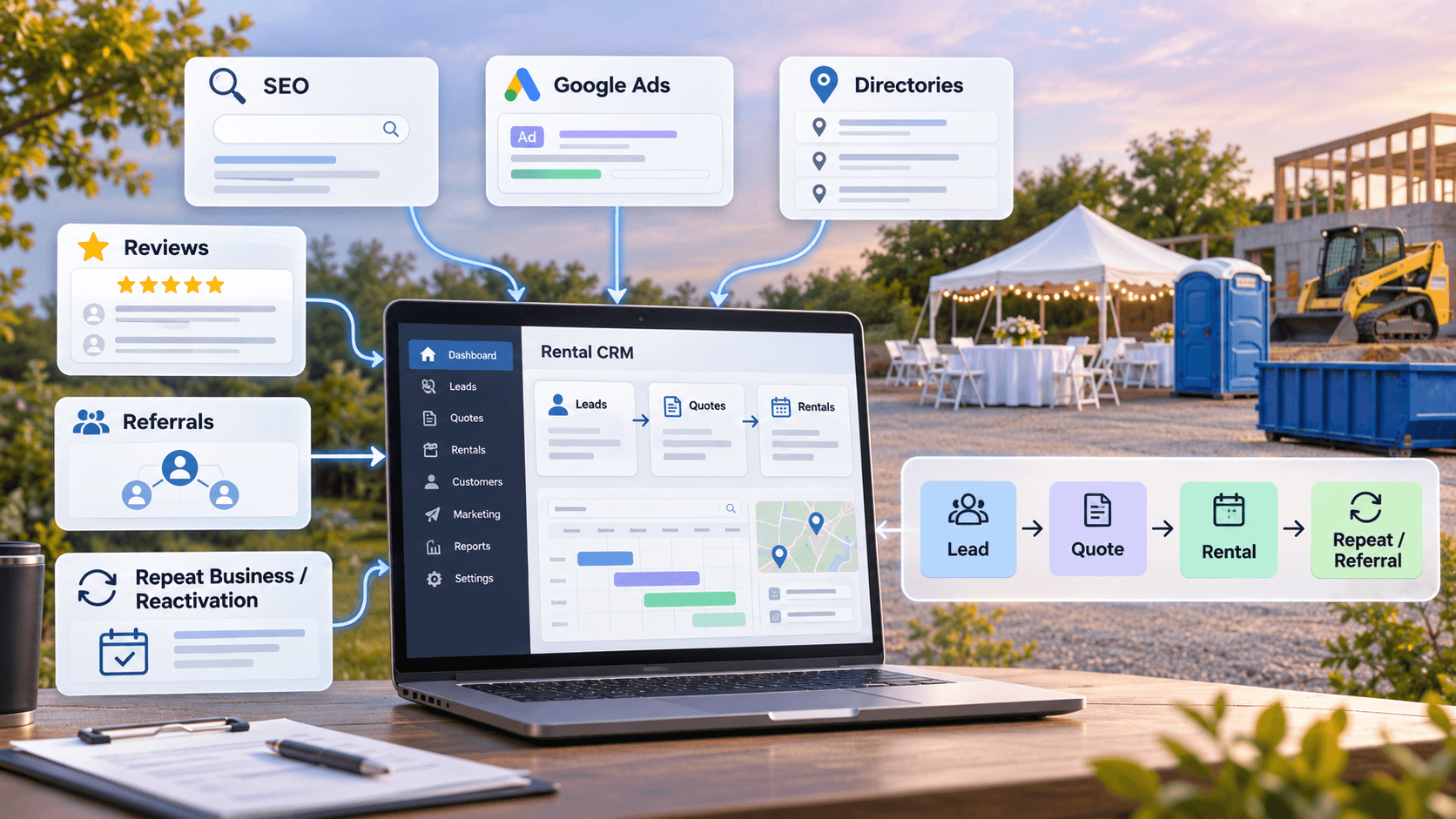
What Marketing Channels Work Best for Rental Companies? SEO, Google Ads, Directories, Referrals, and Repeat Business
SEO, Google Ads, directories, reviews, referrals, outbound, and repeat business all solve different problems — here's how to decide where a rental company's budget and attention should go.
Customer Acquisition
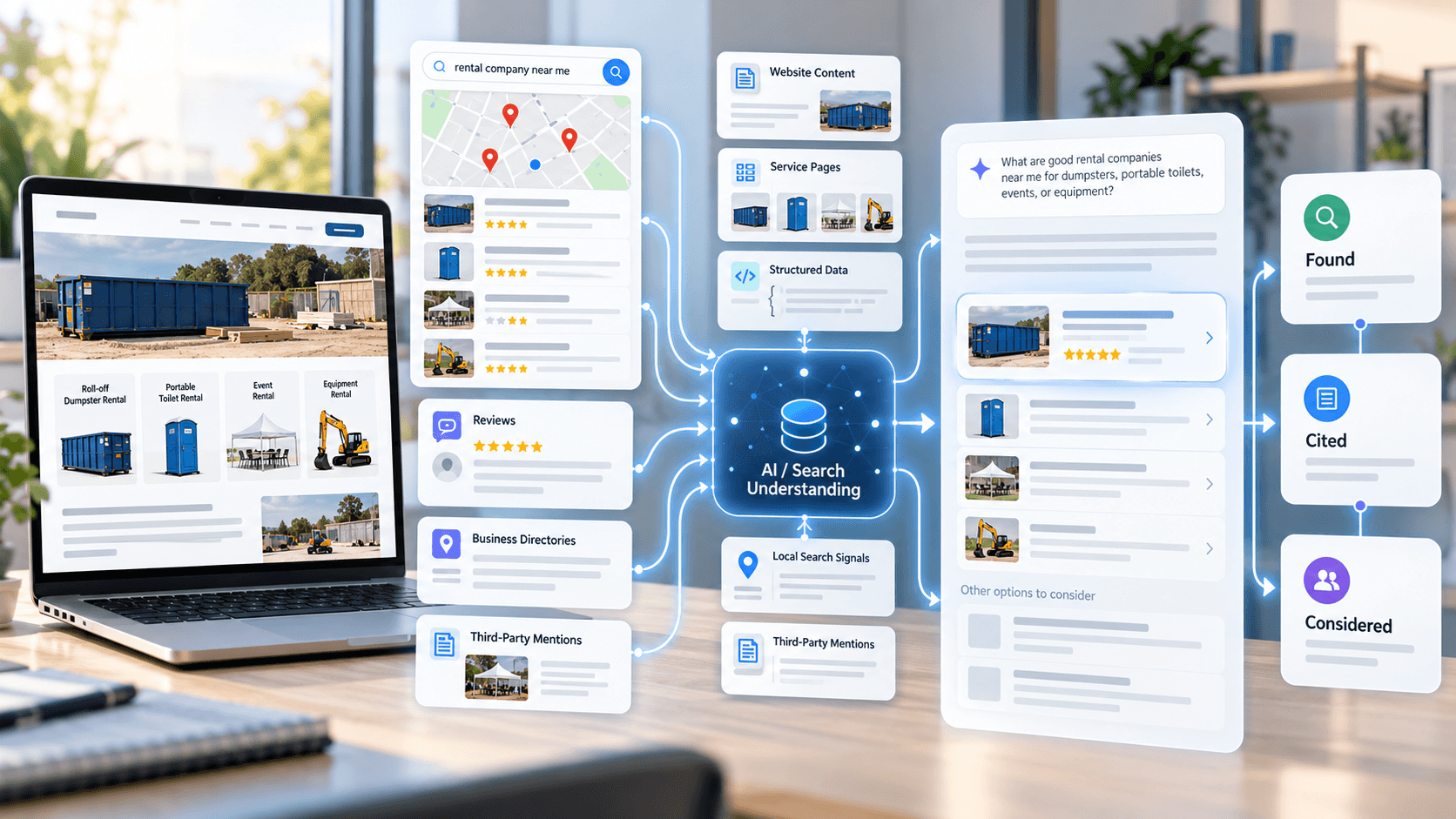
How Can a Rental Company Get Found in ChatGPT, Google AI, and Other AI Search Tools?
AI search isn't a separate discipline from SEO — it's an extension of it. Here's what actually helps a rental company show up in ChatGPT, Google AI, and similar tools.
Digital Infrastructure
How Rental Companies Can Improve Speed-to-Lead
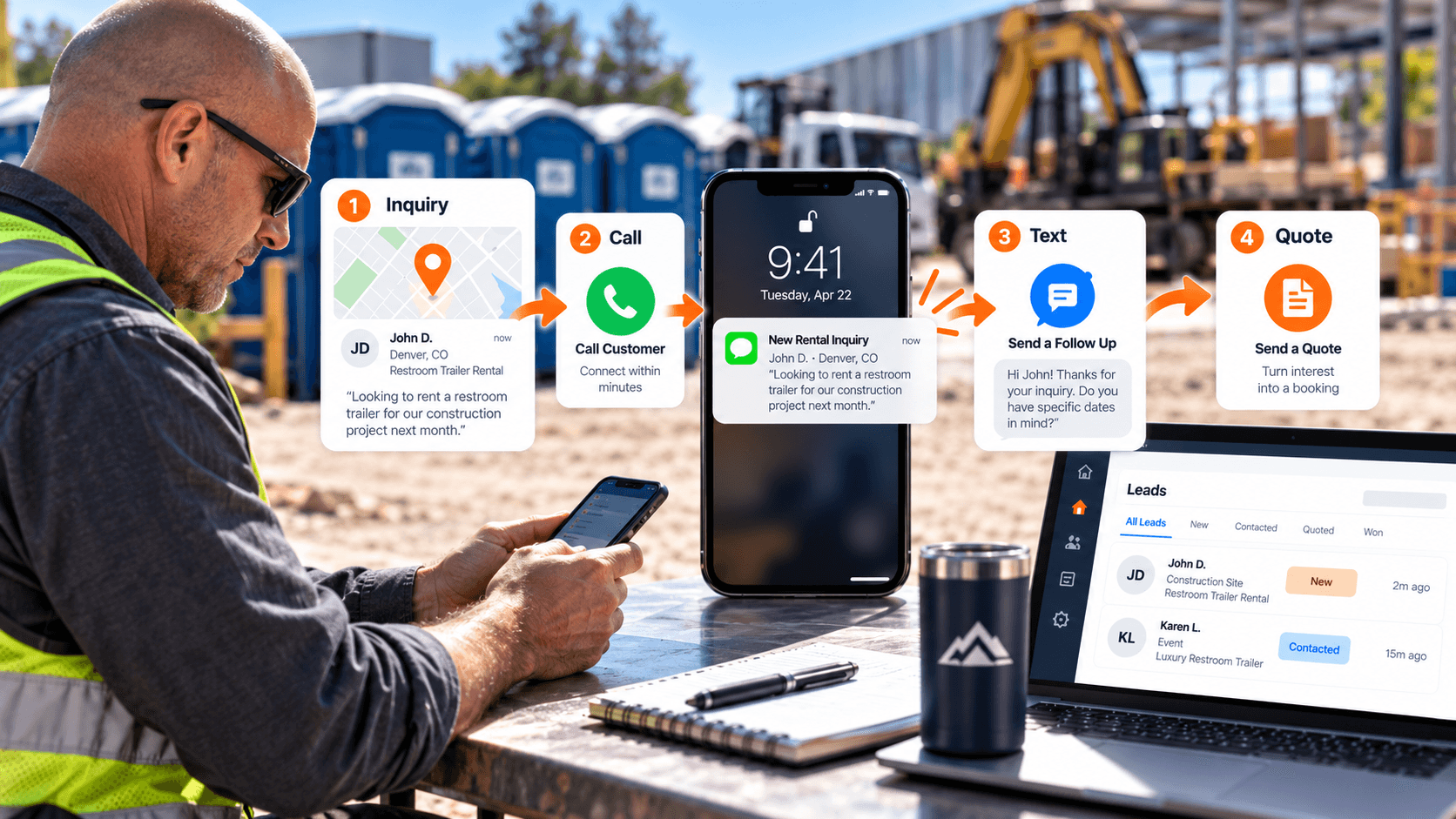
In commoditized rental categories, the company that responds first often wins the job. Here's how to shorten your response time.