Customer Acquisition
What Marketing Channels Work Best for Rental Companies? SEO, Google Ads, Directories, Referrals, and Repeat Business
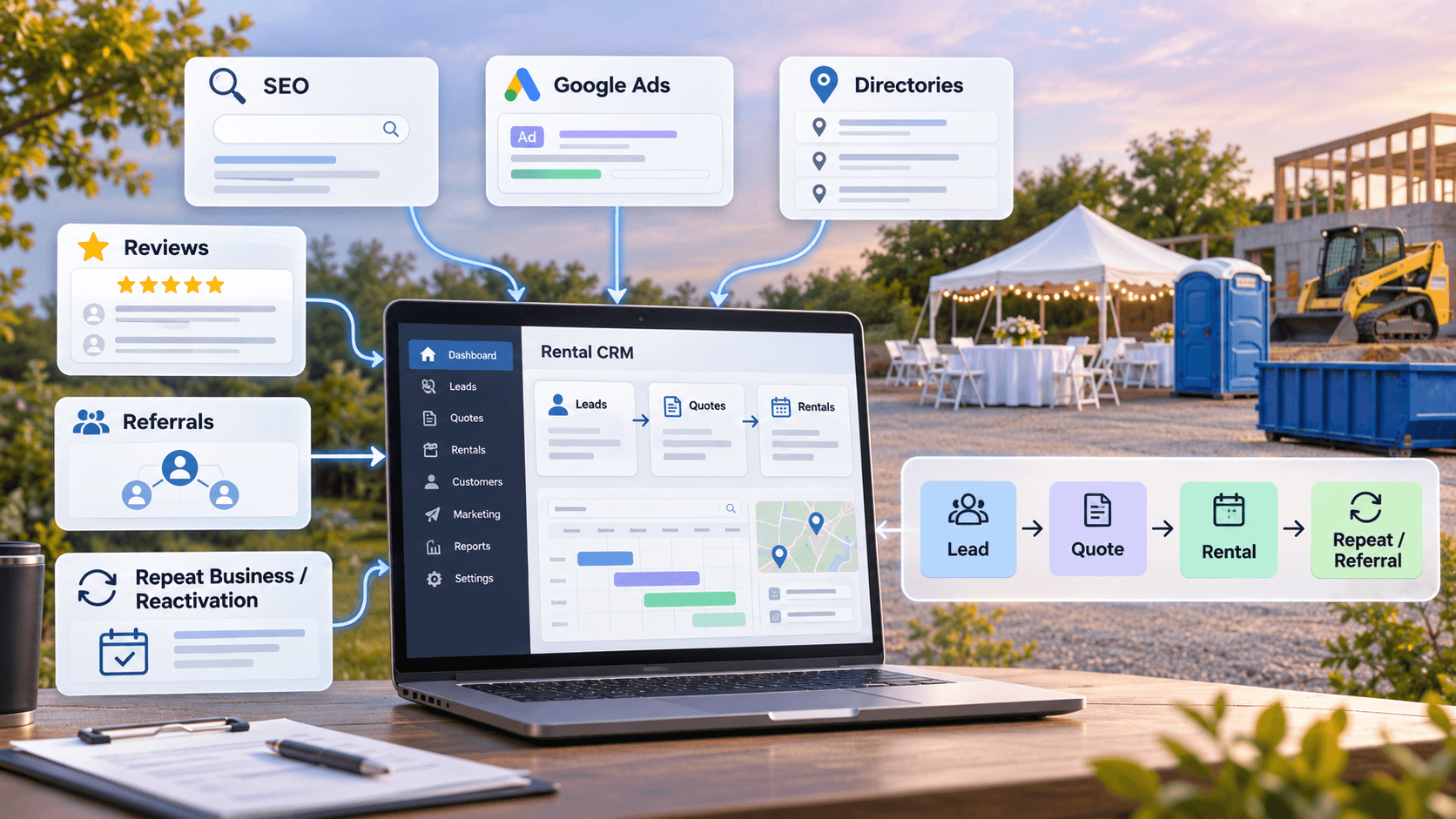
The rental companies that market themselves well rarely rely on one channel. The strongest mix usually combines a fast channel that captures demand right now (Google Ads, Google Business Profile), a channel that compounds over time (SEO, directories, content), trust signals that help convert that demand (reviews, third-party mentions), and a way to get more value out of customers who already rented (reactivation, referrals, repeat business).
Which of these matter most, and in what order, depends on the business's stage, budget, market, and how fast it can respond to a new lead. A brand-new dumpster rental company and a ten-year-old portable toilet company with three trucks are not making the same decision.
There Is No Single Best Marketing Channel
Two companies offering nearly the same service in neighboring markets can end up with completely different ideal channel mixes, because the variables that matter most aren't really about the service — they're about the business running it.
- Budget — determines whether paid channels or slower organic channels make more sense right now
- Market and competition — a saturated metro area behaves differently than a market with two competitors
- Service area — a tight local radius favors Google Business Profile and local search over broad paid campaigns
- Average ticket — a $3,000 event rental and a $350 dumpster drop justify different acquisition costs
- Repeat frequency — businesses with regular repeat customers get more value from reactivation than one-off rentals do
- Sales capacity — a channel that generates more leads than the team can call back isn't actually helping
- Speed-to-lead — fast channels like Google Ads only pay off if someone answers quickly
- Operational capacity — a channel is only as good as the crew's ability to deliver on what it promises
A company that's tried five channels for two weeks each hasn't really tested five channels.
How to Evaluate a Rental Marketing Channel
Instead of asking which channel is "best," it's more useful to evaluate each one against the same set of criteria.
- Speed — how quickly it can produce a lead
- Cost — what it costs to run, in spend or time
- Intent — how close the lead is to actually wanting to rent
- Control — how much the business can adjust or improve it
- Compounding value — whether it keeps paying off without repeated spend
- Repeatability — whether it works consistently or only occasionally
- Tracking — how easily results can be measured and attributed to it
- Fit — whether it suits a small operation or needs scale to work well
No channel scores well on all eight. That's the point — they're meant to be combined, not ranked.
SEO for Rental Companies
SEO is the practice of improving a website and Google Business Profile so a company shows up in organic search results and the map pack for the services it offers in the areas it serves, without paying per click.
Strengths
- Keeps working without ongoing ad spend once visibility is established
- Captures high-intent searches like "dumpster rental near me"
- Supports local and service-area pages that also help with Maps visibility
- Feeds the same content AI search tools pull from when answering rental questions
- Reduces dependence on paid traffic over time
Weaknesses
- Slower to show results than paid channels
- Competitive in crowded metro markets
- Requires ongoing content and technical quality, not a one-time project
SEO tends to work best for companies planning to be around for years, not weeks. See our category-specific guides on dumpster rental SEO, portable toilet rental SEO, and event rental SEO for more detail.
Google Business Profile and Local Search
A Google Business Profile is the free listing that shows a company's name, reviews, hours, and location in Google Maps and the local map pack above organic results.
Strengths
- Captures nearby, ready-to-call searchers
- Drives phone calls and direction requests directly
- Rewards accurate categories, reviews, and photos
- Strong fit for companies serving a defined local area
Weaknesses
- Limited control over the ranking factors themselves
- Harder to stand out in dense, competitive markets
- Performance depends on profile accuracy and review volume, which require upkeep
This is foundational, not optional. A company skipping its Google Business Profile to focus on other channels is skipping the listing most local customers see first.
Google Ads
Google Ads lets a rental company pay to appear at the top of search results for specific keywords — the fastest way to turn on demand on command.
Strengths
- Produces leads quickly, often within days of launch
- Measurable, assuming conversions are tracked correctly
- Captures existing high-intent search demand
- Useful for testing a new service area or offer before committing long-term
Weaknesses
- Costs money for every click, good or bad
- Broad-match keywords can burn budget on irrelevant searches
- Weak landing pages and quote forms waste the traffic a campaign generates
- Gets expensive fast without disciplined tracking feeding it
Google Ads can create leads quickly. It can also create invoices quickly. It works best when a company can respond to a new lead fast and can see, lead by lead, which ones actually turned into a booked rental.
Rental Directories
Rental directories are third-party sites that list rental companies by category and service area, giving customers another place to find and compare options beyond a single company's own website.
Strengths
- Adds discovery surface area beyond a company's own site
- Provides category-specific context that search engines and AI tools can reference
- Can produce direct referral leads from the directory itself
- Reinforces local and service-area relevance across the broader web
Weaknesses
- Not all directories carry the same weight — quality and relevance matter more than quantity
- A listing alone doesn't guarantee leads
- Best treated as one input in a broader visibility strategy, not a replacement for one
Rental Growth Systems operates a small network of category-specific directories built on the same idea: a listing is one piece of visibility, not the whole plan.
Here's what that looks like in practice — a real rental company featured across directory pages, city pages, and resource content to create more visibility where customers are already searching.
Reviews
Reviews aren't a channel that generates traffic on their own — they're what makes every other channel work better.
Strengths
- Builds trust with a customer comparing several companies
- Improves conversion from phone calls and quote requests
- Supports local search credibility and map-pack visibility
- Reinforces confidence for a customer who found the company through ads, SEO, or a directory
Weakness
Reviews don't generate demand by themselves — a company with great reviews and no other acquisition channel still isn't visible to anyone searching.
See our guide on how to get more Google reviews for a practical review-request system.
Referrals and Partnerships
Referral relationships with contractors, venues, planners, builders, property managers, municipalities, and complementary vendors can produce some of the highest-intent leads a rental company gets — the referring party has already vouched for the business.
Strengths
- Warm intent — the lead arrives with built-in trust
- Relationship leverage that compounds over years, not campaigns
- Often converts at a higher rate than cold channels
Weaknesses
- Slower to build than a paid or organic channel
- Less predictable volume month to month
- Requires ongoing relationship maintenance, not just an initial ask
Customer Reactivation and Repeat Business
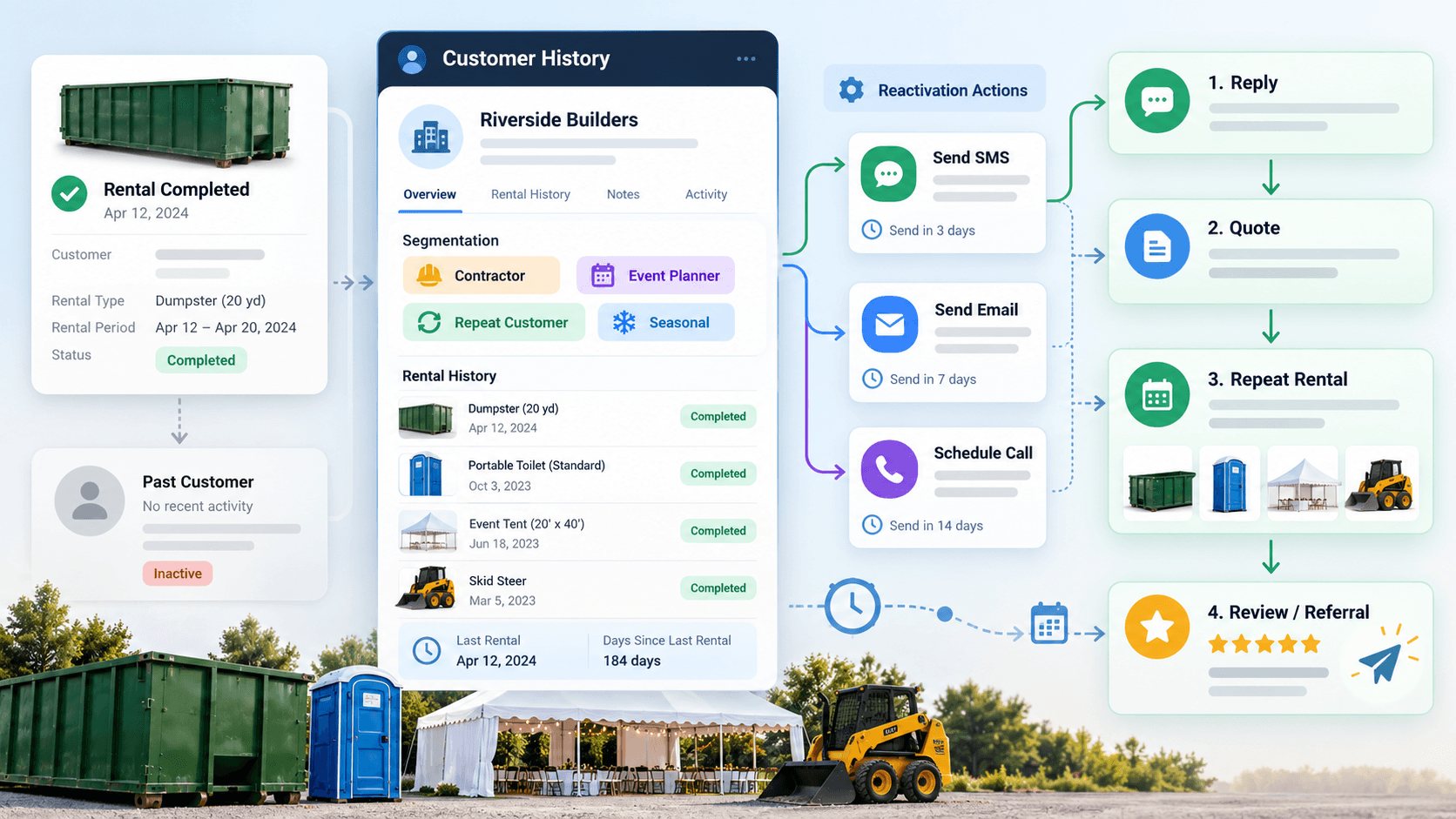
Reactivation means going back into a company's own customer history and reaching out to past renters who haven't booked again — often the most underused channel a rental company has.
Strengths
- The relationship and trust already exist
- Lower friction than earning a brand-new customer
- Meaningfully increases what each customer is worth over time
Weaknesses
- Requires clean, accessible customer history to work from
- Segmentation and timing matter — a dumpster customer from six months ago and a wedding customer from last October need different timing
See our guides on customer reactivation for rental companies and tracking customer history for how to build this properly.
Outbound and Local Business Development
Outbound covers calls, email, direct mail, networking, and direct local partnerships — the parts of marketing that involve a person reaching out rather than waiting for demand to arrive.
Strengths
- Targeted at specific accounts worth pursuing
- Useful for B2B relationships like builders or property managers
- Fully controllable — no algorithm or bidding involved
Weaknesses
- Labor-intensive relative to the leads it produces
- Requires real targeting to avoid wasting time
- Can feel spammy when done without specificity or relevance
SEO vs Google Ads for Rental Companies
Neither is categorically better — they solve different problems on different timelines.
SEO
- Slower to build
- Compounds without an ongoing per-click cost
- Less direct control over exact placement
- Becomes a long-term asset
Google Ads
- Faster to produce leads
- Costs continue as long as spend continues
- More control over exact placement and targeting
- Stops producing leads the moment spend stops
Many rental companies run both at once — Google Ads for immediate demand while SEO builds toward needing less of it over time.
Are Rental Directories Worth It?
It depends on the directory, not on directories as a category.
Worth considering when a directory offers:
- A category genuinely relevant to the services offered
- Real local or service-area visibility, not just a generic national listing
- Traffic that's actually qualified for rental services
- Enough context and content around the listing to support search and AI visibility
Not every directory clears that bar, and a listing on even a strong directory isn't a guarantee of leads — it's additional surface area, evaluated the same way as any other channel.
What Marketing Channels Work Best for a New Rental Company?
A brand-new rental company doesn't need every channel on day one. A practical starting mix:
- Google Business Profile, filled out completely and accurately
- A basic website with clear service pages
- Google Ads or another controlled, trackable lead source
- A simple review-request system
- A basic CRM or follow-up process, even a simple one
- One or two directories relevant to the category
This combination covers local visibility, a fast and trackable lead source, trust, and basic follow-up — most of what a new company needs before adding anything else.
What Marketing Channels Work Best for a Growing Rental Company?
Once the basics are working and tracked, a growing company typically adds:
- SEO and content
- Paid search running alongside it, not instead of it
- Additional, more targeted directories
- An active reactivation process
- Referral and partnership relationships
- Better attribution, so each channel's actual contribution is visible
What Marketing Channels Work Best for a Mature Rental Company?
- Diversification, so no single channel is a point of failure
- An SEO and content moat that's hard for competitors to replicate quickly
- Direct brand search demand
- A mature repeat-business and reactivation program
- Deeper, longer-running partnership relationships
- Multi-channel reporting and attribution
Which Channels Compound Over Time?
Some channels get more valuable the longer a company invests in them, without needing proportionally more spend.
- SEO and content
- Backlinks and third-party mentions
- Directory presence built up over time
- A growing base of reviews
- Partnership relationships
- The customer database itself
These are worth protecting even when they're not the fastest-moving line in a report.
Which Channels Produce the Fastest Results?
When a company needs demand quickly, a few channels respond fastest:
- Google Ads
- Outbound to warm or targeted contacts
- Referrals from existing relationships
- Reactivating the existing customer database
Fast isn't the same as cheap or scalable — these channels tend to need the most ongoing attention to keep producing.
Which Channels Are Best for High-Intent Leads?
High-intent leads are people actively looking to rent, not just browsing.
- Google Search and Google Ads
- Google Business Profile and the map pack
- Relevant rental directories
- Referrals from a trusted source
Which Channels Are Best for Customer Value?
Customer value channels don't bring in new customers — they increase what existing ones are worth.
- Reactivation campaigns
- Structured repeat-business outreach
- Reviews that build trust for the next rental
- Referrals generated by past customers
- Cross-selling related services to an existing customer base
How Should a Rental Company Split Its Attention?
Rather than fixed percentages, it's more useful to think in three roles:
- One short-term channel generating demand right now
- One compounding channel building visibility for later
- One customer-value channel increasing what existing customers are worth
A common version: Google Ads for short-term demand, SEO as the compounding channel, and reactivation or referrals for customer value. The specific channels can change — the three roles shouldn't disappear.
A Simple Rental Marketing System
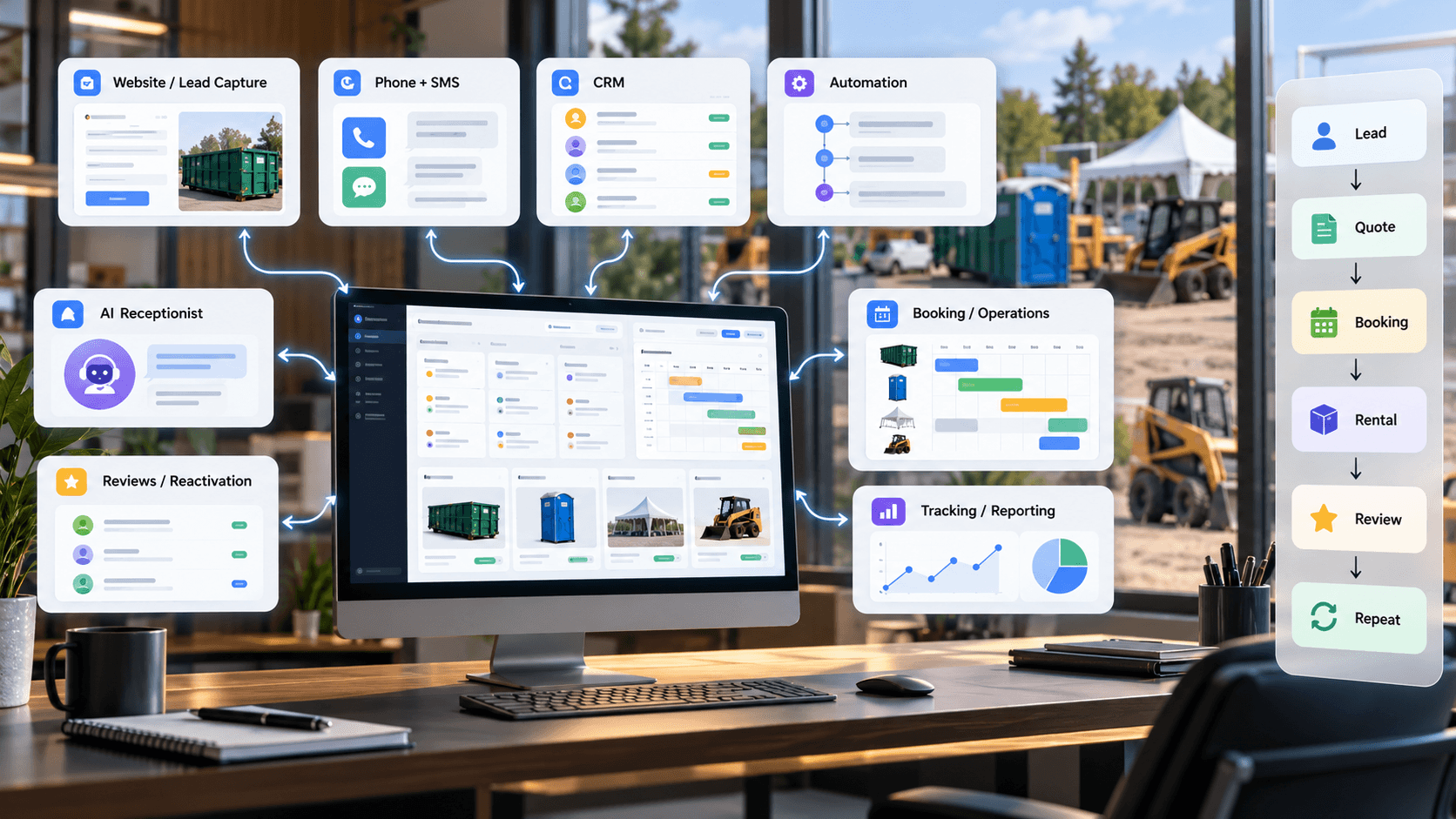
All of this works best as one connected system rather than separate initiatives:
- Google, Ads, directories, and referrals create demand
- The website and phone capture the lead
- A CRM keeps track of it
- Fast follow-up keeps it from going cold — see our guide on rental company speed-to-lead
- A quote gets sent
- The rental happens
- A review gets requested
- The customer gets reactivated later
- That turns into a repeat rental or a referral
Common Rental Marketing Mistakes
- Relying on a single channel and treating it as the whole strategy
- Chasing more traffic without tracking where leads actually come from
- Sending paid or organic traffic to weak, generic landing pages
- No fast follow-up on new leads
- No CRM or structured way to track a lead through to a booked rental
- No consistent review-request process
- Ignoring past customers entirely after the first rental
- Buying low-quality or unqualified leads to hit a volume target
- Judging SEO as a failure after a few weeks
- Building a marketing plan out of whatever software got bought, rather than what the business actually needs
A marketing plan made of seven unrelated tactics is still seven unrelated tactics.
How to Measure Which Channels Are Actually Working
Clicks and impressions aren't the goal — booked rentals are. More traffic doesn't help much if every lead still disappears into voicemail.
- Lead volume by source
- How many of those leads are actually qualified
- How many turn into booked rentals
- Revenue by lead source over time
- Repeat business attributable to reactivation or past customers
- Cost, where a channel has a direct cost attached
None of this is possible without tracking lead source consistently, which is usually a CRM problem before it's a marketing problem. See our guide on the rental business tech stack and Digital Infrastructure Systems.
What Should a Rental Company Work on First?
- Fix lead capture so no inquiry gets missed
- Fix response time so leads get a fast follow-up
- Track where every lead actually comes from
- Set up and complete the Google Business Profile
- Test one fast, controllable channel like Google Ads
- Build one compounding channel, usually SEO
- Add a consistent review-request process
- Add relevant directories and partnership relationships
- Add a reactivation process for past customers
- Expand into new channels only once tracking is reliable enough to measure them
The Bottom Line
Rental companies don't need every marketing channel running at once. They need a small group of complementary channels that capture demand now, build visibility over time, create trust, and generate value from customers who already rented.
That's the same thinking behind Rental Growth Systems' Customer Acquisition Systems and Customer Value Systems — demand and customer value working as one system rather than two separate budgets.
Frequently Asked Questions
What marketing channels work best for rental companies?
Most rental companies do best with a combination: a fast channel for immediate demand (like Google Ads or Google Business Profile), a compounding channel for long-term visibility (like SEO), reviews and third-party mentions for trust, and reactivation or referrals to get more value from past customers. The right mix depends on budget, market, and business stage.
Is SEO or Google Ads better for a rental company?
Neither is universally better. Google Ads produces leads faster but stops the moment spend stops; SEO takes longer to build but keeps working without an ongoing cost per click. Many rental companies run both at the same time, using each for what it's good at.
Are rental directories worth it?
It depends on the specific directory. A relevant, category-specific directory with real local visibility can add discovery and context; a generic or low-quality one adds little. A listing on any directory is one input in a broader strategy, not a guarantee of leads.
What is the fastest way to generate rental leads?
Google Ads, targeted outbound, referrals from existing relationships, and reactivating the company's own customer database tend to produce results fastest. None of them work well without fast follow-up once the lead actually arrives.
What marketing channel has the best long-term value?
SEO is usually the strongest long-term asset because visibility compounds without an ongoing per-click cost. Reviews, directory presence, partnerships, and the customer database itself also build value over time rather than resetting with each new budget cycle.
How should a small rental company market itself?
Start with the basics: a complete Google Business Profile, clear service pages, one controllable lead source like Google Ads, a simple review-request process, and basic follow-up tracking. That covers local visibility, trust, and a trackable way to generate and respond to leads before adding more channels.
Should rental companies focus on new leads or repeat customers?
Both, but repeat customers and reactivation are often underused. New-lead channels get most of the attention, while most rental companies have a customer history sitting mostly untouched. Reactivation campaigns typically cost less and convert faster than acquiring an unfamiliar customer.
How do rental companies know which marketing channels are working?
By tracking lead source through to booked rentals and revenue, not just clicks or form submissions. That requires recording where every lead came from and following it through the pipeline — usually a CRM and process question before it's a marketing question.
Related Resources
Digital Infrastructure
The Rental Business Tech Stack: CRM, Automation, AI, Tracking, and Growth Tools
What a rental company's technology actually needs to do — and why the right stack is the one where the pieces share information, not the one with the most tools.
Customer Value
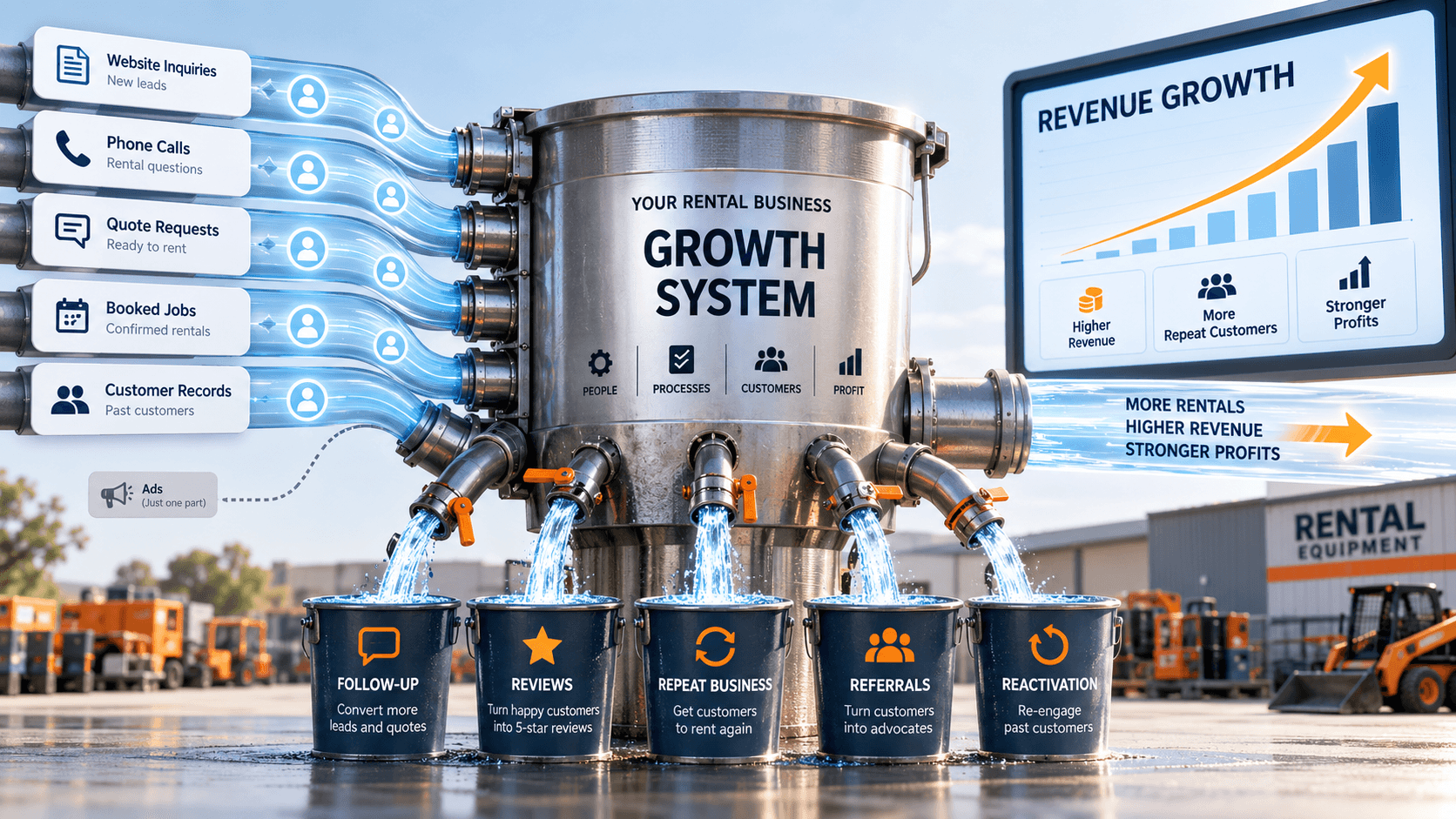
How to Grow a Rental Business Without Spending More on Ads
More ad spend isn't always the answer — here's how rental companies create growth from the leads and customers they already have.
Customer Value
Customer Reactivation for Rental Companies: How to Turn Past Customers Into Repeat Revenue
Most rental companies already have revenue sitting in their customer database. Here's how to turn past customers into relevant, well-timed repeat opportunities.